The information on this website is general in nature and does not take into account your objectives, financial situation, or needs. Consider seeking personal advice from a licensed adviser before acting on any information.
Australian tradies face a mix of on-site, business, vehicle, tool and income risks. This guide explains the main types of insurance tradespeople commonly consider and how different cover types may fit together depending on the trade, business structure and work performed.
There is no single type of policy that suits every trade business. The types of tradie insurance a carpenter, plumber, electrician, tiler, landscaper or builder may consider can vary depending on the work performed, the tools and vehicles used, the job sites attended, and whether the business operates as a sole trader, subcontractor or employer.
This guide explains common insurance cover types for tradespeople in Australia and how they may fit together as part of a broader business insurance approach. It is general information only, not personal advice. Policy availability, pricing, limits, exclusions and suitability depend on your circumstances and the insurer's criteria.
Why tradies often need a tailored insurance approach
Tradespeople can face risks that are different from many office-based businesses. A typical working week may involve travelling between job sites, carrying expensive tools, working in customers' homes or commercial premises, using vehicles for business, and relying heavily on physical capacity to earn income.
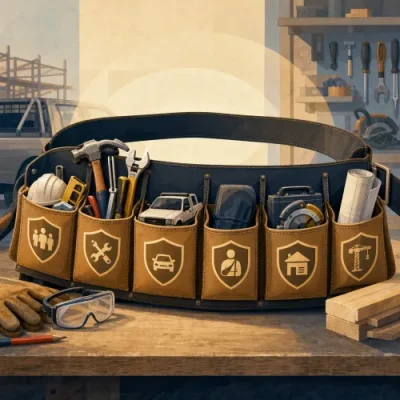
Because of this, business insurance for tradies is often built from several cover types rather than one standard policy. A tailored approach may help align cover with risks such as:
- injury or property damage claims arising from work activities;
- theft, loss or damage to tools and equipment;
- damage to a work ute, van, trailer or other business vehicle;
- loss of income if illness or injury prevents you from working;
- damage to workshop contents, stock or business premises contents;
- project-related risks during construction, renovation or installation work;
- contractual insurance requirements imposed by builders, head contractors, landlords or clients.
A one-size-fits-all package may leave gaps or include cover that is not relevant. The aim is not simply to buy more insurance, but to understand which risks could affect your livelihood and which cover types may respond.
Common types of insurance for tradespeople in Australia
The following cover types are commonly considered by Australian tradespeople. Not every tradie will need every option, and some policies may overlap or include optional extensions. Reading the Product Disclosure Statement, policy wording and schedule is important before deciding whether a policy is appropriate.
| Cover type | What it generally relates to | Common tradie relevance |
|---|
| Public liability insurance | Claims by third parties for injury or property damage connected to your business activities | Often requested for work on residential, commercial or construction sites |
| Tools and equipment insurance | Theft, loss or damage to insured tools and portable equipment | Relevant where tools are essential to earning income |
| Commercial vehicle insurance | Vehicles used for business, such as utes, vans, trailers or trade vehicles | Important where the vehicle is central to getting to jobs and transporting tools |
| Income protection insurance | Replacement of a portion of income if illness or injury prevents work, subject to policy terms | Relevant for self-employed tradies who rely on physical work |
| Workshop contents and stock cover | Business contents, stock, machinery or materials kept at a premises | Relevant for trades with workshops, yards or storage facilities |
| Contract works or construction insurance | Damage or loss affecting works in progress, materials or project-related property | May be relevant for builders, renovators and some contractors |
| Professional indemnity insurance | Claims connected to professional advice, design, specification or consulting services | May be relevant where advice, design or certification forms part of the service |
Public liability insurance
Public liability insurance is one of the most commonly discussed forms of insurance for tradespeople. It generally relates to claims made by third parties for personal injury or property damage arising from your business activities.
For example, a claim could arise if a customer, visitor or member of the public alleges that your work caused injury or damaged property. The exact scope of cover depends on the policy wording, exclusions, excesses and limits.
Public liability may also be required under contracts or before entering certain job sites. However, having a policy does not mean every incident will be covered. Tradies should consider the activities listed on the policy, any height, excavation, hot works, asbestos, product, subcontractor or hazardous work exclusions, and whether the limit is adequate for the type of work undertaken.
For a deeper look at choosing this cover, see the guide to public liability insurance for Australian tradies.
Tools and equipment insurance
Many tradies rely on tools every day. If key tools are stolen from a vehicle, damaged on-site or lost in transit, the cost and downtime can be significant. Tools and equipment insurance is designed to respond to certain insured events affecting business tools, portable equipment or sometimes larger items of plant, depending on the policy.
Important details to check include:
- whether tools are covered in vehicles overnight;
- security requirements for vehicles, trailers, worksites or storage areas;
- single-item limits for expensive tools or specialised equipment;
- whether accidental damage is included or only theft and specified events;
- whether hired-in equipment, mobile phones, laptops or testing equipment need separate cover;
- how depreciation, replacement value or proof of ownership is handled at claim time.
Tool insurance for tradies can be particularly relevant for self-employed tradespeople because replacing essential tools may otherwise come directly from cash flow.
Commercial vehicle insurance
A ute, van, trailer or truck may be one of the most important business assets a tradie owns. Personal car insurance may not be appropriate if the vehicle is used for trade or business purposes, so commercial vehicle insurance is commonly considered.
Depending on the policy, cover may relate to accidental damage, theft, fire, storm, third-party property damage, towing, hire vehicle options and accessories or modifications. The vehicle's use, drivers, garaging address, claims history and the type of cover selected can all affect price and availability.
Tradies should also check whether tools, stock or materials inside the vehicle are covered under the vehicle policy, a separate tools policy, or not at all. For more detail, read the guide to commercial vehicle insurance for Australian tradies.
Income protection insurance
For many tradespeople, the ability to work is the main income-producing asset. Income protection insurance is designed to pay a portion of income if the insured person cannot work due to illness or injury, subject to the policy terms.
This cover can be especially relevant for self-employed tradie insurance planning, as sole traders and subcontractors may not have access to paid sick leave. However, income protection policies vary significantly. Key features to review include waiting periods, benefit periods, benefit amounts, definitions of disability, exclusions, occupation rating, tax treatment and how income is assessed for self-employed applicants.
Income protection is not the same as workers compensation, personal accident insurance or life insurance. If you are weighing up options, see the guide to income protection insurance for tradies.
Workshop contents, stock and business premises cover
Some trades operate from a workshop, warehouse, storage unit, yard or small business premises. In those cases, insurance may need to extend beyond tools carried in a vehicle.
Workshop contents or business property cover may include insured events affecting machinery, benches, stock, spare parts, fixtures, computers, records, customer goods or materials kept at the premises. Policies may also offer extensions for business interruption, theft, fire, storm, glass, machinery breakdown or electronic equipment, depending on the insurer and selected cover.
When reviewing this area, consider where property is kept, whether materials move between the workshop and job sites, who owns customer goods, and whether any lease or finance agreement imposes insurance obligations.
Contract works and construction-related cover
Contract works insurance, sometimes called construction insurance, may be relevant for builders, renovators and some contractors involved in projects where works in progress, materials or structures could be damaged before completion.
This cover is different from public liability. Public liability generally focuses on third-party injury or property damage claims, while contract works cover may relate to the project itself, materials on-site, temporary works or certain insured events affecting the works during the construction period.
Who needs to arrange contract works cover can depend on the contract, project value, role on the job, principal contractor requirements and insurer criteria. Subcontractors should not assume they are automatically covered by a builder's policy. It is worth checking contract terms and asking clear questions before starting work.
Professional indemnity and advice-related risks
Some trades only perform physical installation or repair work. Others also provide advice, design input, reports, specifications, inspections, project management or certification-style services. Where a client relies on professional advice or design work, professional indemnity insurance may be relevant.
Professional indemnity generally responds to certain claims alleging professional negligence, error or omission in the provision of professional services. It is not a substitute for public liability and may not be needed by every trade. The need for this cover depends on the services provided, contracts signed, licensing or industry obligations, and the potential consequences if advice or design work is alleged to be wrong.
Other cover types some tradies may consider
Depending on the business, additional insurance may also be worth discussing with a broker or insurer. Examples include:
- Workers compensation: compulsory requirements vary by state and territory and by whether you employ workers. Sole traders and contractors should check the rules that apply to their structure and location.
- Personal accident and illness cover: sometimes considered where income protection is unavailable or not selected, although benefits and definitions can be different.
- Management liability: may be relevant for companies with directors, employees or employment-related exposures.
- Cyber insurance: may be relevant where the business stores customer data, uses online booking systems, accepts electronic payments or relies on business software.
- Goods in transit: may be relevant where tools, stock, materials or customer goods are frequently transported.
- Plant and machinery cover: may be relevant for excavators, scissor lifts, compressors, generators or other higher-value equipment.
These options are not automatically necessary for every tradie. They are examples of cover types that may become relevant as a trade business grows or changes.
How different cover types can work together
A tailored insurance package is usually about combining relevant cover types in a way that reflects how the business operates. For example, a self-employed electrician may focus on public liability, tools, commercial vehicle and income protection. A plumbing business with employees, a workshop and multiple vehicles may need a broader structure, including workers compensation obligations, business property cover and vehicle policies. A builder managing renovation projects may need to consider contract works and subcontractor-related requirements.
The right mix depends on practical questions such as:
- What work do you perform, and are all activities disclosed to the insurer?
- Do you work in homes, commercial premises, strata properties, industrial sites or construction sites?
- Do contracts specify minimum public liability limits or other required insurance?
- What tools, vehicles, plant, stock or materials would be costly to replace?
- Could the business keep operating if you were injured or ill?
- Do you employ staff or engage subcontractors?
- Do you provide advice, design, reports or specifications?
- Are there exclusions that affect common tasks in your trade?
These questions can help identify gaps, overlaps and priorities before comparing policies.
Questions to ask before choosing tradie insurance cover types
Before buying or renewing insurance for tradespeople in Australia, it can help to ask structured questions rather than focusing only on premium. Consider asking an insurer or broker:
- Which trade activities are listed on the policy schedule?
- Are subcontractors, labour hire workers or employees treated differently?
- Are tools covered away from the business premises and inside vehicles?
- Are there restrictions for work at heights, underground work, hot works, demolition or hazardous materials?
- Does the public liability limit meet common contract requirements for your jobs?
- Are vehicles insured for business use and for the correct drivers?
- Are optional covers included automatically or only if selected?
- What evidence is needed at claim time, such as invoices, photos, service records or incident reports?
- How do excesses, waiting periods, benefit periods and exclusions apply?
- What happens if the business grows, changes trade activities or takes on larger contracts?
If you need help understanding policy structure or comparing cover options, you can contact a broker referral partner through the broker information page. A broker's role, fees, services and available insurers can vary, so it is important to ask how they are remunerated and what insurers they can access.
Reviewing cover as your trade business changes
Insurance should not be set and forgotten. Tradies often change the way they work over time by buying new tools, adding vehicles, hiring staff, moving into commercial projects, taking on larger contracts or expanding into related services.
A policy that suited a sole trader doing small residential jobs may not suit a growing business working on commercial sites with subcontractors and higher-value equipment. Reviewing your insurance at renewal, after major purchases and before signing larger contracts can help identify whether cover still matches your business activities.
You can also use the Tradies Insurance Australia homepage as a starting point to explore common cover options and request information. Any quote, policy offer or premium will depend on your circumstances, disclosures and provider criteria.
Key takeaways
Australian tradies commonly consider several types of insurance, including public liability, tools and equipment, commercial vehicle, income protection, workshop contents, contract works and, in some cases, professional indemnity or other specialist cover.
The main point is that tradie insurance cover types should reflect the real risks of the work, not just a generic checklist. A sole trader, subcontractor and growing trade business may each need a different mix. Reading policy documents, checking exclusions and reviewing cover as the business changes are practical steps that can reduce the chance of unexpected gaps.
This article provides general information only. Before deciding on cover, consider your objectives, financial situation and needs, and read the relevant policy documents. If required, seek guidance from a licensed insurance professional.
Published: Thursday, 4th Dec 2025
Author: Paige Estritori



No comments yet. Be the first to share your thoughts.